A 2027 vision board is a collage of images and words for the year you want to grow into. Pick three to five areas of life, choose a feeling for each, and find pictures and phrases that carry it. Then add one small, dated step per area, so the board points somewhere real.
How to make a 2027 vision board
You need about an hour, a surface (corkboard, poster card, a notebook page or a phone screen), and something to look back on. Most guides skip that last part, and it’s what makes the board yours rather than a Pinterest copy.
- Look back at 2026 for ten minutes. Write down what you’d like more of, what you’d like less of, and one moment from this year you’d happily repeat. Most of your board is already hiding in that list.
- Pick three to five areas. Home, work, rest, friendship and love, learning, creativity, money. You don’t need all of them; a board with three areas you care about beats one with eight you feel you should.
- Name a feeling for each area. Not “promotion” but “trusted.” Not “new apartment” but “settled.” A feeling gives you more ways to get there than a single outcome does, and it tells you which pictures belong.
- Collect pictures and words. Magazines, your own camera roll, free photo sites, a quick sketch. Gather too much, then keep what still feels right the next morning.
- Put it where you’ll see it. Above the kettle, inside a closet door, as your lock screen. A board in a drawer is a board you made once. Next to each area, write one step with a date on it; we’ll come back to that below.
If you want help with the first step, our manifestation journal prompts are a gentle way into a year-end look back.
Paper, digital or bingo: picking a 2027 vision board format
A paper board is slow in a good way. Cutting and gluing gives you time to think, and it’s hard to scroll past something pinned to your wall. The downside is that it’s fixed; changing your mind in May means more glue.
A digital vision board is easier to keep current. To make one, open any collage or design app (Canva, Pinterest, Freeform, even a notes app), set the canvas to your phone’s screen size, and drop in five to nine images with a few words on top. Export it, save it to an album called “vision board 2027,” and set it as your lock screen, where you’ll see it every time you check the time.
Try our free vision board maker: pick your areas of life, swap in watercolor pictures or your own photos, and save the board at phone or desktop size.
A 2027 vision board bingo card swaps pictures for 24 small things you’d like to do this year, laid out in a five-by-five grid around a free square. It suits people who like checking things off, and it quietly turns wishes into steps. Keep each square small enough to finish in a day or a weekend. Here’s one to play with. Shuffle it, rewrite any square, and tick squares off as the year goes:
Tap a square when you’ve done it, or press Edit squares to swap in your own. Your card is kept in this browser only. A card made of things you actually want to do will get used; a card copied from someone else usually won’t.
2027 vision board ideas for every area of life
These are starting points, not a checklist: each area has a feeling and a few pictures that might carry it. Use them as manifestation board ideas, or simply as prompts for what to look for in a pile of magazines.
Home
settled, lighter, a place to come back to
A tidy corner with one lamp on. Plants on a sill. Clean sheets on a Sunday.
Work
focused, trusted, done by evening
A clear desk at 9 a.m. A laptop closed at a reasonable hour. Someone you’d like to learn from.
Rest and daily habits
rested, unhurried, at home in your body
Walking shoes by the door. A morning with no alarm. A park you could walk to.
Friendship and love
close, easy, part of something
Two cups on a table. A long dinner with people talking over each other. A phone call that runs late because nobody wants to hang up.
Learning
curious, a beginner on purpose
A library card. A half-filled page of a new language. A class schedule pinned to the fridge.
Creativity
playful, making things for their own sake
Paint on your hands. A sketchbook with messy pages. An instrument out of its case.
Money as steadiness and choices
calm, prepared, able to say yes or no
A bill opened without dread. A free afternoon. A trip planned far enough ahead that it feels easy.
You’ll notice there are no stacks of cash, dream bodies, or dream cars on that list. Those images are common, and they tend to set a target someone else defined. Money shows up here as what it buys you in daily life: calm, room, and choices.
Words and phrases for your 2027 board
A few words can do more than a dozen pictures, especially on a phone screen. Pick one word for the year, or one phrase per area. Short beats clever.
Tap up to three words that feel right for the year.
If a word makes you feel pressured when you read it, drop it.
Pictures that aren’t just luxury stock photos
Search for 2027 vision board pictures and you’ll find a lot of infinity pools. There’s nothing wrong with wanting a beautiful view, but a photo of someone else’s villa tells you very little about your Tuesday. As our glossary entry on vision boards puts it, a sunlit room or a shared meal can say more about your wish than a picture of a luxury house.

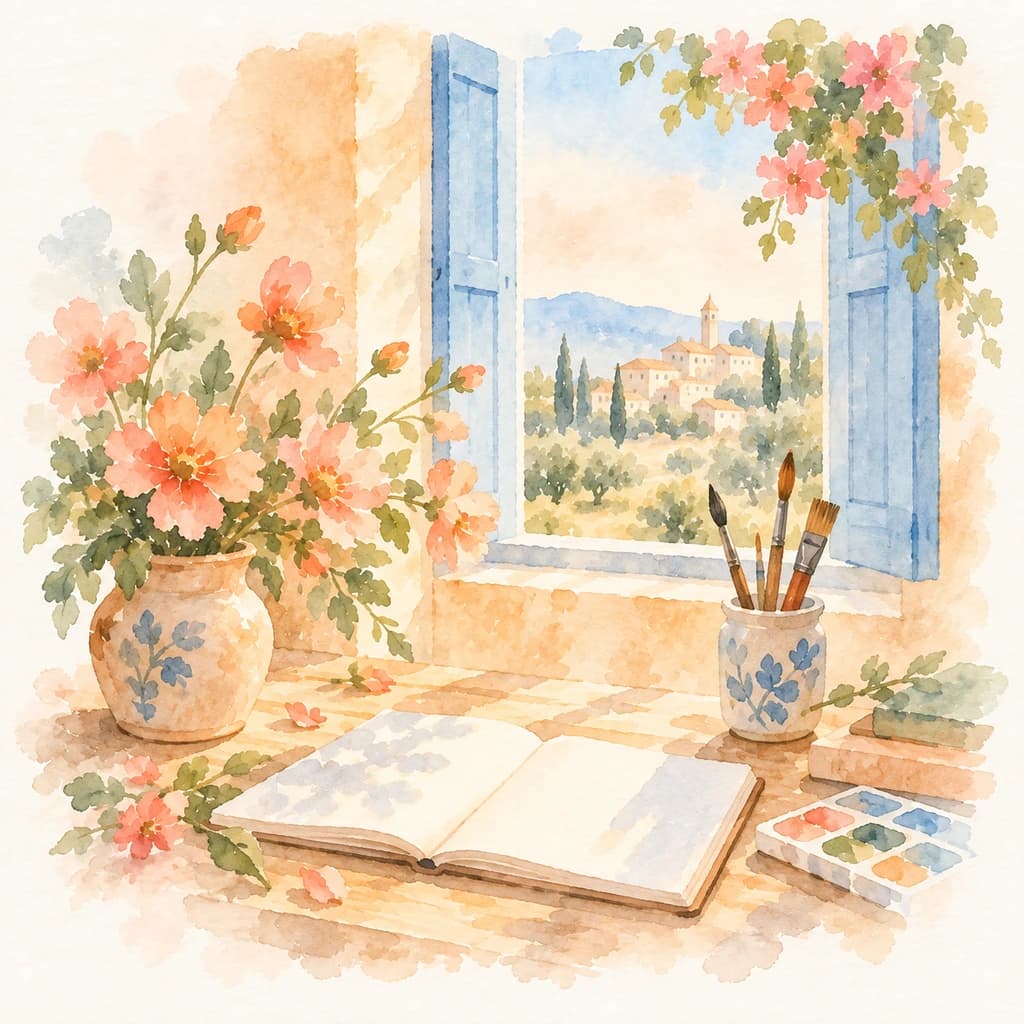
Two easy ways to find pictures that fit:
- Take your own. A photo of your actual window in good light is more personal than any download, and it reminds you that part of what you want is already here.
- Choose ordinary moments. Hands around a mug, shoes by a door, a bus stop on the way to a class you signed up for.
What to put on a vision board (and what to leave off)
Put on anything that makes you want to get up and do something small toward it. A ticket stub, a line from a letter, a photo of yourself on a day you liked who you were. The test for each piece is simple: when you look at it in February, does it still feel like yours?
Some things are better left off:
- Other people’s bodies. A body that isn’t yours is a comparison you’ll make every morning. If health matters to you this year, picture what you’d be doing (a long walk, a swim, a good night’s sleep) rather than how you’d look.
- A specific person. A photo of a crush or an ex turns their choices into your goal. Picture the kind of closeness you want instead. Our glossary’s note on specific-person manifesting explains why consent still matters.
- Pure comparison images. A screenshot of an influencer’s kitchen is usually a feeling of falling behind, not a wish. In a 2015 experiment, women who spent ten minutes on their own Facebook feeds came away in a worse mood than those who browsed a neutral website. Your board shouldn’t do that to you.
- Goals you were handed. If an image is there because you think you should want it, take it down. Space on the board is worth more than filler.
Does a vision board help you manifest? What the research says
So what is a vision board, and how does it work? It’s a visual reminder of an intention, and it works the way a sticky note works: it keeps something in front of your attention. Whether you call yours a 2027 manifestation board or just a board, that part is the same. Manifestation circles often go further and treat the board as a way to draw the pictures toward you. We don’t make that claim, and the research gives a reason to be careful.
In a 2002 paper, psychologists Gabriele Oettingen and Doris Mayer separated two ways of thinking about the future. Expectations are judgments that a wished-for future is likely. Fantasies are how good it feels to picture it. Across four studies of graduates looking for jobs, students with a crush, undergraduates before an exam, and patients having hip-replacement surgery, positive expectations predicted more effort and better results, measured weeks to as long as two years later. Positive fantasies predicted the opposite.
What you picture seems to matter too. In a 1999 study by Pham and Taylor, college freshmen spent five to seven days before a midterm imagining the good grade, the study habits that would earn it, or both. Picturing the process led to more studying and better grades, partly through better planning and less anxiety. If you like visualization, put an ordinary Tuesday of the life you want on the board, not only the big reveal.
Writing about a good future has some support of its own. A 2019 meta-analysis of 29 studies on the best possible self exercise, where you describe a future in which things have gone well after working hard toward it, found small-to-moderate gains in wellbeing, optimism and positive mood. That is about how people felt, not about wishes coming true. A board can do some of the same work, and it helps more when it’s connected to a plan.
How to make a vision board that really works: one plan per area
“Works” here means the modest thing: the board gets used. Oettingen’s later research on mental contrasting pairs the pleasant picture with an honest look at what’s in the way, and a 2021 meta-analysis of 21 studies found that adding an if-then plan to that pairing had a small-to-medium effect on reaching goals. For each area on the board, write a short WOOP on the back or in a note:
- Wish. The area and its feeling. “Friendship: feeling close again.”
- Outcome. What would be different by the end of 2027? “I see two friends at least once a month.”
- Obstacle. Something in you, not out there. “I cancel when I’m tired after work.”
- Plan. An if-then sentence. “If it’s the first Sunday of the month, then I text one friend to make a plan.”
Try it: your WOOP in four lines
Start with one area from your board. You can come back and do the next one later.
Your plan
Fill in the if and then above, and your plan appears here.
Saved only in this browser. Nothing you type is sent anywhere.
That last line is what psychologists call an implementation intention: you decide in advance what you’ll do when a particular moment comes. Put a date on the first one. Then, once a month, look at the board and ask one question per area: did I take the step, and does the picture still fit? Change either one freely.
If all of this is new to you, manifestation for beginners walks through the basics.
Is it too late to make a 2027 vision board?
No. Vision board searches spike in January and fall off in February, but the year doesn’t care when you start. January is only the loudest of many fresh starts: Dai, Milkman and Riis found that gym visits, goal commitments and searches for “diet” all rose after what they call temporal landmarks, including the start of a week, a month or a semester, a birthday and holidays. A board made in March has ten months to be useful, and one made on your birthday has a whole personal year ahead of it.
Starting later also has an advantage: you know more. By spring you’ve seen which January resolutions held, so the board can follow what you actually want, not what the new year told you to want. If you made a January board and stopped looking at it, keep the pieces that still pull at you and add a step to each.
If the year ahead feels heavy
Some people come to a vision board during a hard stretch: a loss, an illness, a job ending. A board can hold hope for that. It can’t replace care, practical help, or people who show up for you. And if parts of the board don’t happen, it isn’t because you pictured them wrong or didn’t want them enough.
A few questions about vision boards
What should I put on a 2027 vision board?
Pictures and words for three to five areas of life you care about, chosen for how they feel rather than what they cost. Then add one small, dated step for each area so the board points at something you can actually do.
Do vision boards actually work?
A board doesn’t make anything happen by itself. Gabriele Oettingen’s research found that enjoying pleasant fantasies about a goal tended to go with less effort toward it, while expecting it to be possible went with more. Her later work pairs the wish with the obstacle in the way and a plan. Use the board as a reminder of where you’re heading, not as a promise.
When should I make my 2027 vision board?
Many people make one in late December or January, but any time works. Your birthday, the first warm week of spring, or a Sunday in March are all fine starting points.
What is a manifestation board?
Another name for a vision board, used by people who see it as part of a manifestation practice. The making is the same either way: pictures, words, and a place where you’ll see them.
Can I make a vision board on my phone?
Yes. A digital board on your lock screen or in a notes app is easy to see every day and easy to change when the year changes you.
Sources we opened for this guide: G. Oettingen and D. Mayer, “The motivating function of thinking about the future: Expectations versus fantasies,” Journal of Personality and Social Psychology 83, no. 5 (2002): 1198–1212. L. B. Pham and S. E. Taylor, “From thought to action: Effects of process- versus outcome-based mental simulations on performance,” Personality and Social Psychology Bulletin 25, no. 2 (1999): 250–260. A. Carrillo et al., “Effects of the Best Possible Self intervention: A systematic review and meta-analysis,” PLoS ONE 14, no. 9 (2019): e0222386. G. Wang, Y. Wang and X. Gai, “A meta-analysis of the effects of mental contrasting with implementation intentions on goal attainment,” Frontiers in Psychology 12 (2021): 565202. H. Dai, K. L. Milkman and J. Riis, “The fresh start effect: Temporal landmarks motivate aspirational behavior,” Management Science 60, no. 10 (2014): 2563–2582. J. Fardouly et al., “Social comparisons on social media: The impact of Facebook on young women’s body image concerns and mood,” Body Image 13 (2015): 38–45. The steps, idea lists and bingo card are MurMur editorial suggestions, not a clinical protocol, and we make no claim that a vision board changes outcomes on its own.